
What do we think as a country about repairs? We know we’re a damp, draughty country: and in 2023 we now have levelling up (and Michael Gove)

What we also need is a re imagination of the relationship between the trades we say we value as well as the people who use the services. The people who repair and maintain things need to have the time and space to acknowledge and understand how things can improve for the people they see every day.
Everyone needs to see and feel that they are changing things, that they can see the impact of their work and to see that the infrastructure is changing, developing, growing.
Our country is full of amazing people who want to do the right thing by their families, children, throughout their lifetimes: but we need to ensure that they get real opportunities in their neighbourhoods. To do this I’d argue to do this we need to turn all high street charities into neighbourhood community interest companies providing real jobs with links to colleges and unis for CPD throughout the lifetime.
If Michael Gove wanted to steer this the recent Lifelong Learning Entitlement of £37,000 could be at the heart of a neighbourhood economy that could transform lives. We need to start thinking of people who live in social or private rented accommodation as having the same aspirations and potential as everyone else except they have more structural distractions.
When working class people are in colleges often they’re not seen as individuals: and the courses they’re on are under-resourced. If they’ve had difficulties in the past they’re compounded by the lack of time and support resources to catch up so often they feel that there’s no real sense that society wants them to catch up. We need to care that there are enough resources in the neighbourhood to maintain and build houses, new businesses, new opportunities for everyone across the lifespan.
Repair, Restore, Renew people and organisations at the same time. When you look on the parliament UK website, in November 23, there are 430,00 housing repair references. It’s a hot topic just now https://websearch.parliament.uk/?q=housing+repairs
Shaun Hutchinson and Kevin Fearn of MTVH maintenance company Metworks work in building maintenance.
Below are some of the skills that Kevin and Shaun have and can bring to a job:
Flaunching is also known as benching. It’s a mixture of mortar usually 3:1 very strong sand and cement holding the chimney pot in place at the top of a chimney stack. Flaunching is also used to help to keep rain from damaging the brick or stone at the top of the stack.

Gutter Installation

EPDM Installation EPDM IS A RUBBER ROOFING MEMBRANE It’s extremely durable and long lasting. EPDM stands for ethylene propylene diene terpolymer, with the primary two ingredients being ethylene and propylene. The EPDM rubber membrane is a synthetic rubber that is used in a number of applications because of the advantages it offers.

Above: Construction Manager Chris Brown’s drawing showing the use of an EPDM membrane
A Dry Ridge system is a method of using screws or other mechanical fixings to attach ridge tiles to a roof. This eliminates the need to use mortar for bonding. Screws or other mechanical fixings attach clamps between the joins of each and every roof tile, which then clamp the tiles to the roof. Below examples of Dry Ridge Roofing:

Dry verge systems, or dry-fixing, is a roofing system that involves caps or verges that interlock, clipping over the edge of the roof tiles, protecting the tiles, keeping them secured and preventing water and pests from entering the roof space.
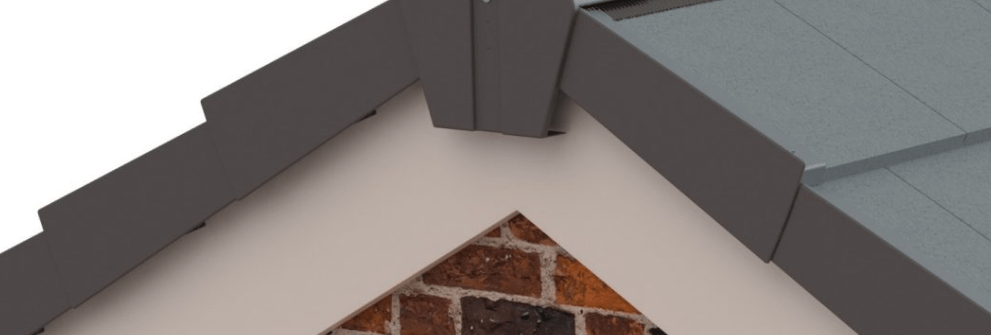
Above Dry Verge System
The function of leadwork is to provide a waterproof roof, but it’s still part of the overall structure. While incredibly durable and corrosion-resistant, lead flashing is exposed to the same extreme weather conditions which can affect the health of a roof.
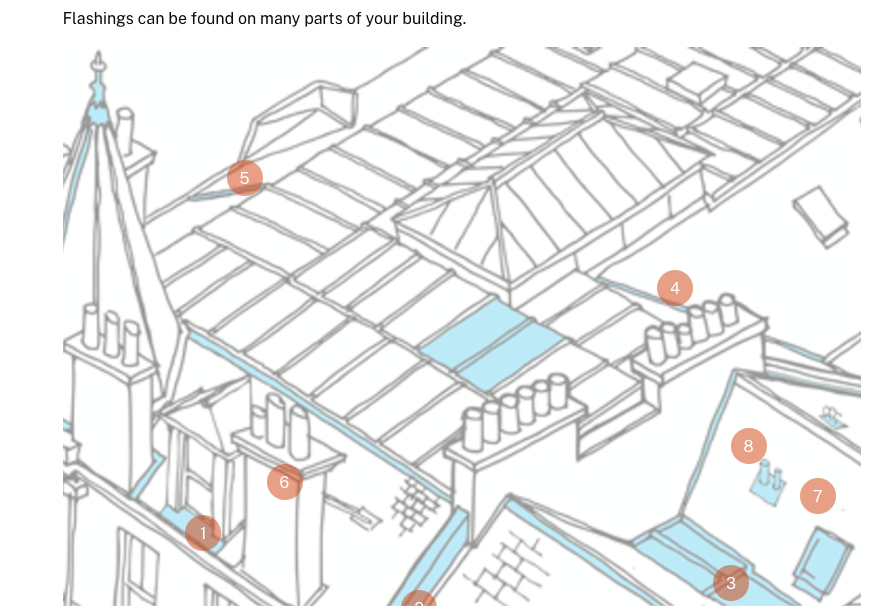
Above: Flashing
Repointing is the process of repairing and renewing the pointing in between your brick. This process replaces the old mortars and makes sure that the bricks are bonded together again. Repointing is essential for maintaining, protecting, and conserving brick and stone buildings.
Pitched Roofs A pitched roof is a roof that slopes downwards, typically in two parts at an angle from a central ridge, but sometimes in one part, from one edge to another. The ‘pitch’ of a roof is its vertical rise divided by its horizontal span and is a measure of its steepness.
Pitched roofs are built to withstand snow, ice, water and wind. Shaped as a triangle, they are stable, stronger and ensure perfect water drainage. Some roofing tiles, like natural slate, are extremely tough, waterproof and fire-resistant.
Re bedding is removing the old mortar and resetting ridge caps. The cement supports the ridge cap (refer photo on right) so the next stage – rebedding – can be done. Rebedding may be required when the mortar is broken or badly cracked. There are many reasons why this process may be done
Fascia. The fascia board is the long, straight board that runs along the lower edge of the roof. The fascia is fixed directly to the lower ends of the roof trusses and usually does all the work of supporting the lower edge of the bottom row of tiles. The fascia board also carries all the guttering.
Like many parts of a home’s exterior, soffit serves both an aesthetic and a functional purpose. Functionally, the basic mission of soffit is to protect rafters from the elements. Keeping moisture away from the rafters reduces the chance of mould, and helps preserve the life of the materials.
Chimneys work by removing byproduct gases, like carbon dioxide, from the air. Its function is not to remove hot air but to instead remove hot gases from the heating unit used in your home.
Roof tiles are overlapping tiles designed mainly to keep out rain or snow, and are traditionally made from locally available materials such as clay or slate. Later tiles have been made from materials such as concrete, and plastic
Roofing slates are roofing tiles made out of slate. The rock is split into thin sheets which are cut to the requires size before shipment. This contrasts to slabs which are milled to produce larger structural components. They are the primary product of the slate industry.
Roof maintenance Inspect Your Shingles Regularly. Regular roof inspections should be part of your routine maintenance Inspect Any Openings Remove Debris Keep Your Gutters Clean Trim Branches.
The damaged or old gutters, support brackets, and pipes will be removed. The new guttering and downpipes are then fitted and connected to existing drains at ground level. A water test is then conducted to ensure the guttering and pipework have been installed at the correct angle and flows freely into downpipes.
Kevin and Shaun have much to offer to the levelling up conversation, let’s get more people involved, more of the time.

 signsofanopencity
One thought on “Skills? Here’s a few we grew over a lifetime: Cheers, Michael: Kevin and Shaun”
Comments are closed.